In the BIM industry, the focus is gradually shifting from just delivering coordinated models to delivering meaningful and usable information. While design accuracy and clash-free models remain important, the true value of BIM is realized during the operational phase of a building. This is where structured data and its long-term usability become critical.
Two terms that are often discussed in this context are Asset Information Model and Asset Data Management. They are closely related and sometimes used interchangeably, but they represent different aspects of information handling in BIM. Understanding the difference between them helps ensure better project delivery and more efficient facility management.
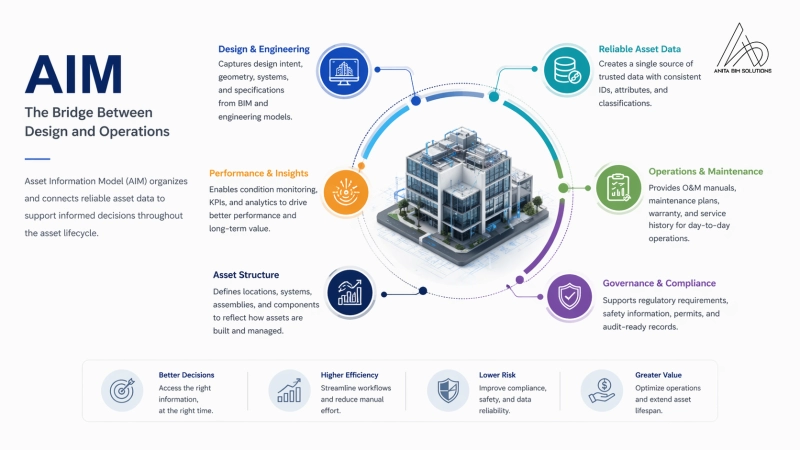
An Asset Information Model (AIM) is a structured, validated set of asset data delivered at the end of a BIM project. It is developed from the Project Information Model (PIM) and tailored specifically for the needs of facility management.
AIM includes:
Rather than being just a 3D model, AIM is a data-rich, organized information resource that enables building owners and facility managers to operate and maintain the asset efficiently from day one.
In essence, AIM is the final information deliverable of BIM.
What is Asset Data Management?
Asset Data Management refers to the process of managing asset-related information throughout the lifecycle of a building or infrastructure.
It involves:
Unlike AIM, which is delivered at a specific stage, Asset Data Management is continuous and dynamic. It ensures that the information remains accurate, relevant, and useful long after project completion.
Although they are interconnected, AIM and Asset Data Management serve different roles within the BIM ecosystem.
Nature
AIM is a deliverable, while Asset Data Management is an ongoing process.
Timeline
AIM is prepared and handed over at the end of design and construction, whereas Asset Data Management continues throughout the entire lifecycle of the asset.
Responsibility
AIM is typically developed by BIM teams and project stakeholders, while Asset Data Management is handled by facility managers and operations teams.
Purpose
AIM provides structured and validated asset information, while Asset Data Management ensures that this information is maintained, updated, and effectively used.
Understanding their relationship is key to unlocking the full potential of BIM.
AIM acts as the foundation, and Asset Data Management builds on it.
If AIM is incomplete or poorly structured, facility teams struggle to use the data. On the other hand, if Asset Data Management is not implemented effectively, even a high-quality AIM will quickly become outdated.
Both must work together to ensure continuity of information across the asset lifecycle.
A well-developed AIM enables a seamless transition from construction to operations. When combined with proper data management practices, it allows facility teams to start using the information immediately without delays or confusion.
With accurate AIM data and ongoing management:
This results in more efficient and organized facility operations.
Structured data from AIM, when properly managed, supports:
This leads to significant cost savings over the building’s lifecycle.
Asset Data Management ensures that information is continuously updated and accessible. This allows facility managers to make informed decisions based on real data rather than assumptions.
As the industry moves toward smart buildings and digital twins, both AIM and Asset Data Management become critical.
AIM provides the initial data structure, while Asset Data Management keeps it alive and connected to real-time systems.
To maximize the benefits of both AIM and Asset Data Management:
In the BIM industry, project success is no longer defined by design and construction alone. The true performance of a building depends on how well information is structured, delivered, and continuously managed throughout its lifecycle. Asset Information Model and Asset Data Management together play a vital role in ensuring that BIM data remains accurate, relevant, and valuable long after project completion.
While AIM establishes a strong and reliable information foundation at handover, Asset Data Management ensures that this data evolves with real world operations, supporting better decisions, efficient maintenance, and long term asset performance. As the industry continues to move toward data driven workflows, professionals equipped with the right practical knowledge in these areas will have a clear advantage.
At Anita BIM Solutions, we focus on bridging this gap by providing industry oriented BIM training with real project exposure, helping learners understand not just modeling, but the complete lifecycle value of BIM including AIM and asset data workflows.