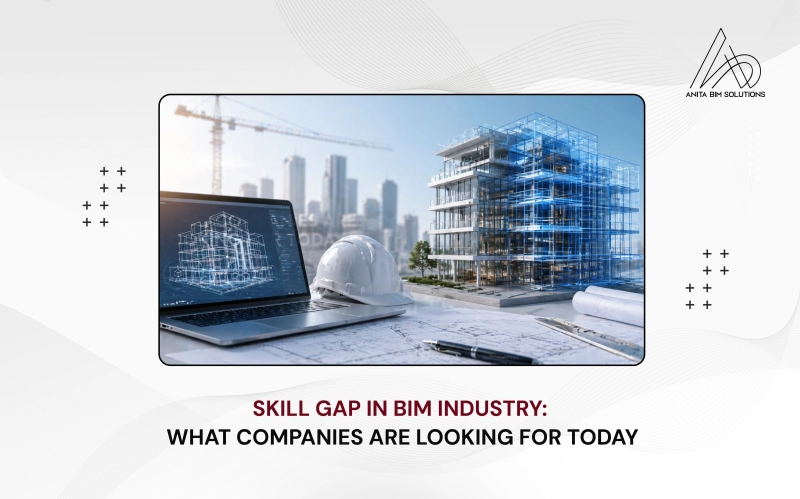
The Building Information Modeling industry is growing rapidly across India and globally, becoming a standard in modern construction projects. From design to facility management, BIM plays a key role in improving efficiency and collaboration.
However, despite this growth, companies continue to face a major challenge. There is a clear gap between the skills professionals have and the skills the industry actually requires. This gap is not due to a lack of jobs but due to a lack of industry-ready talent.
Understanding the Skill Gap in BIM
The main issue lies in how BIM is learned versus how BIM is practiced.
Most learners focus on software tools, while companies expect professionals to understand complete project workflows. BIM is not just about creating models. It involves managing information, coordinating disciplines, and supporting the entire project lifecycle.
This leads to a situation where candidates may know the tools but struggle to apply them in real project environments.
What Companies Are Looking For Today
To bridge this gap, it is important to understand what employers actually expect from BIM professionals.
Software knowledge is the foundation, but it is no longer enough on its own.
Companies expect:
The focus is on applying software in real project scenarios, not just knowing commands.
BIM projects involve multiple disciplines working together, making coordination essential.
Professionals should be able to:
This helps reduce site errors and improves project efficiency.
3. Knowledge of BIM Standards and Workflows
Standardization is a key part of modern BIM practices.
Companies look for familiarity with:
Understanding these ensures consistency and quality across projects.
4. Understanding of Common Data Environment
A Common Data Environment is critical for managing project information.
Professionals should be able to:
This ensures that all stakeholders work with accurate and updated information.
5. 4D and 5D BIM Knowledge
The industry is moving beyond basic 3D modeling.
Companies value professionals who understand:
These skills connect design with execution and decision making.
6. Automation and Computational Skills
Automation is becoming an important part of BIM workflows.
Key expectations include:
These skills help reduce manual effort and increase productivity.
7. Domain Specialization
General knowledge is no longer sufficient in many cases.
Companies prefer specialists in:
Specialization allows professionals to handle discipline-specific requirements more effectively.
8. Real Project Experience
One of the biggest gaps in the industry is the lack of practical exposure.
Employers look for candidates who:
Practical experience builds confidence and improves job readiness.
9. Communication and Collaboration Skills
BIM is a collaborative process that involves multiple teams.
Professionals must:
Strong communication ensures smoother project execution.
The BIM industry is clearly shifting from tool-based learning to process-based expertise.
To stay relevant, professionals should focus on:
This approach significantly improves career opportunities and growth.
The skill gap in the BIM industry highlights changing expectations rather than limited opportunities. Companies are actively looking for professionals who can go beyond modeling and contribute to real project delivery.
Those who focus on practical knowledge, coordination skills, and industry standards will stand out in today’s competitive market. As BIM continues to evolve, professionals who adapt to these requirements will play a key role in shaping the future of the construction industry.
Start Building Industry-Ready BIM Skills Today
Bridging the skill gap requires more than learning software. It requires structured training, real project exposure, and a clear understanding of how BIM works in real industry environments.
At Anita BIM Solutions, our training programs are designed to make you job ready by focusing on:
Whether you are a student, fresher, or working professional, the right training can make a significant difference in your career.
Take the next step toward becoming an industry ready BIM professional.
Join Anita BIM Solutions and gain the skills that companies are actively looking for today.