The Autodesk ecosystem has undergone significant changes over the past few years, leaving many BIM professionals confused about where BIM 360, Autodesk Construction Cloud (ACC), and Autodesk Forma fit into today's workflows.
A common misconception in the industry is that Autodesk Forma has replaced BIM 360. In reality, these platforms serve different purposes within the project lifecycle. Understanding their roles is essential for architects, engineers, contractors, and BIM managers looking to implement efficient digital workflows.
In this article, we'll explore the transition from BIM 360 to Autodesk Construction Cloud, the emergence of Autodesk Forma, and how these platforms work together in modern BIM projects.
Understanding the Evolution of Autodesk's BIM Ecosystem
Several years ago, BIM 360 was Autodesk's primary cloud-based platform for project collaboration, document management, coordination, and construction workflows.
As project requirements became more complex and connected, Autodesk expanded BIM 360 into a broader platform known as Autodesk Construction Cloud (ACC). At the same time, Autodesk introduced Forma, a new cloud solution focused on early-stage planning and conceptual design.
Today, these platforms are not direct replacements for one another. Instead, they support different phases of the building lifecycle.
The Evolution Timeline
Traditional BIM Workflow
- Design Software
- BIM 360 Collaboration
- Construction Execution
Current Autodesk Workflow
- Autodesk Forma
- Revit and Design Tools
- Autodesk Construction Cloud
- Construction and Facility Management
The shift reflects Autodesk's vision of creating a connected digital workflow from project conception to operation.
What Was BIM 360?
BIM 360 was designed primarily for project collaboration and construction management.
Its key functions included:
- Cloud-based document management
- Model coordination
- Clash detection
- Issue tracking
- Construction administration
- Team collaboration
For many years, BIM 360 became the industry standard for multidisciplinary BIM coordination.
However, BIM 360 was focused mainly on design development and construction phases. It offered limited functionality during the earliest stages of project planning and feasibility analysis.
What Is Autodesk Construction Cloud (ACC)?
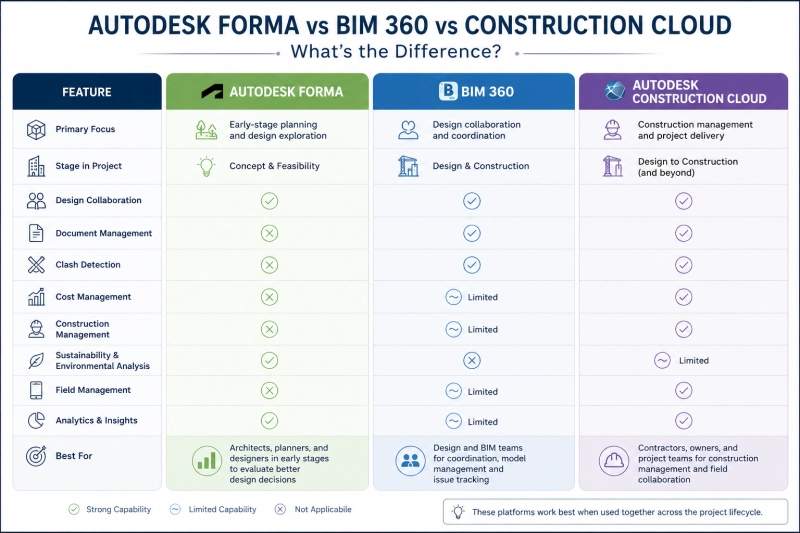
Autodesk Construction Cloud is the modern evolution of BIM 360.
Rather than being a single application, ACC is a connected platform that brings together project data, teams, workflows, and construction processes under one ecosystem.
Key capabilities include:
Document Management
Centralized storage and version control for project files.
Design Collaboration
Collaboration between architects, structural engineers, MEP consultants, and project stakeholders.
Model Coordination
Automated clash detection and model review workflows.
Cost Management
Budget tracking, forecasting, and financial control.
Build and Field Management
Site inspections, issue tracking, quality control, and safety management.
Insights and Analytics
Project performance dashboards and data-driven decision-making.
In simple terms, Autodesk Construction Cloud expands the capabilities of BIM 360 while creating stronger connections between design teams and construction teams.
What Is Autodesk Forma?
Autodesk Forma represents a completely different stage of the project lifecycle.
Forma focuses on early-stage planning, conceptual design, and data-driven decision-making before detailed BIM models are developed.
Its primary goal is to help project teams make better design decisions during the initial phases of a project.
Key features include:
Site Analysis
Evaluate environmental conditions and site constraints.
Solar and Daylight Studies
Analyze sunlight exposure and building performance.
Wind and Microclimate Analysis
Assess environmental impacts on design concepts.
Early Design Exploration
Generate and compare multiple design options quickly.
Sustainability Evaluation
Support performance-based design decisions from the beginning.
AI-Assisted Planning
Leverage automation and generative design tools to optimize project outcomes.
Unlike BIM 360 or ACC, Forma is not intended for construction coordination or project management.
Its focus is helping designers answer important questions before detailed modeling begins.
Real-World Workflow Comparison
Consider a commercial building project.
Phase 1: Planning and Feasibility
The design team uses Autodesk Forma to:
- Analyze site conditions
- Evaluate massing options
- Study daylight performance
- Compare sustainability outcomes
- Assess design alternatives
At this stage, detailed BIM models may not yet exist.
Phase 2: Detailed BIM Design
The selected concept moves into Revit for:
- Architectural modeling
- Structural design
- MEP development
- Detailed BIM coordination
Phase 3: Project Collaboration
The project team uses Autodesk Construction Cloud to:
- Share models
- Manage documents
- Review design changes
- Coordinate disciplines
- Resolve clashes
Phase 4: Construction Execution
Contractors and site teams use ACC to:
- Manage RFIs
- Track issues
- Monitor progress
- Perform quality inspections
- Coordinate field activities
This workflow demonstrates that Forma and ACC are complementary rather than competing platforms.
Has Autodesk Forma Replaced BIM 360?
The short answer is no.
Autodesk Forma has not replaced BIM 360.
What actually happened is:
- BIM 360 evolved into Autodesk Construction Cloud.
- Autodesk Forma was introduced as a new platform for pre-design and conceptual planning.
- Autodesk's strategy now covers the entire project lifecycle, from feasibility studies to construction delivery.
Many professionals mistakenly assume that Forma is the new name for BIM 360 because both are Autodesk cloud products. However, their purposes are fundamentally different.
Conclusion
As the Autodesk ecosystem continues to evolve, understanding the distinct roles of Autodesk Forma, BIM 360, and Autodesk Construction Cloud is essential for BIM professionals. While BIM 360 laid the foundation for cloud-based collaboration, Autodesk Construction Cloud has expanded those capabilities into a more comprehensive project delivery platform. Autodesk Forma, on the other hand, brings powerful data-driven insights to the earliest stages of design and planning.
Rather than replacing one another, these platforms work together to create a connected workflow that supports projects from concept development to construction execution. For professionals looking to stay ahead in the BIM industry, developing expertise across these tools is becoming increasingly valuable.
For those seeking industry-focused BIM training in Kerala, Anita BIM Solutions stands out as a leading institute offering comprehensive BIM courses backed by live project training, practical workflow exposure, and guidance from experienced industry professionals. By combining software proficiency with real-world project experience, Anita BIM Solutions helps students and professionals build the skills needed to succeed in today's rapidly evolving BIM environment.